By Amy Schabacker Dufrane
Bringing your whole self to work results in higher levels of employee engagement and productivity; however, it’s not without challenges. These days, political polarization is challenging HR professionals—“stress-testing” the wellbeing programs put in place to ensure employees can feel and do their best.
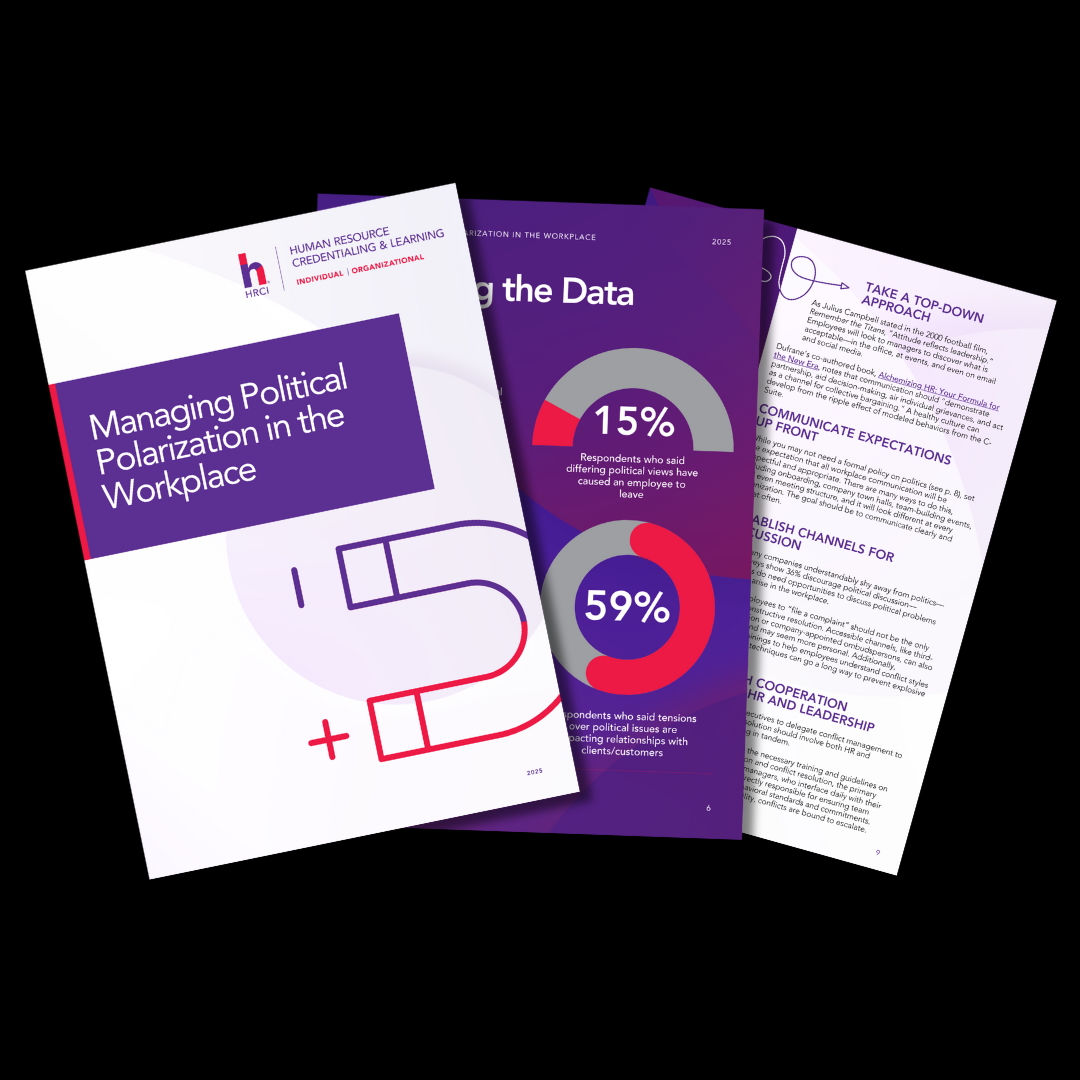
HRCI recently dug into this topic in our latest white paper, “Managing Political Polarization in the Workplace.” When HRCI queried thousands of HR professionals around the world in October 2024 by asking “How prepared do you feel your organization is to handle politically charged discussions?” The majority (55 percent) said they are, minimally, or not at all prepared to handle politically charged discussions at work.
According to a 2024 study by Pew Research Center, a large majority of Americans see little to no common ground between the two major political parties. At the same time, only 20 percent of those surveyed in the Edelman Trust Barometer said they would be willing to serve as a co-worker with some who strongly disagreed with them, implying that 80 percent would not.
While simply asking employees to refrain from political discussions at work might seem like a practical request, we know that’s unrealistic. We’ve asked employees to bring their authentic selves to work, to be comfortable and creative, and to be fully present. Directly linked to fostering trust, this approach – over time – can result in better collaboration and improved business outcomes. It builds culture, values multiple viewpoints, and encourages innovation.
The upside has a downside, one that has become glaringly apparent in these times of strong opinions and divisiveness. HRCI’s data showed that 27 percent of HR professionals have witnessed or heard a political argument at work. More than half of our respondents (59 percent) said that political polarization also impacts relationships with customers.
A conflict-riddled workplace is stressful, and stress is a contributing factor to voluntary (and involuntary) terminations. Workplace stress can crush productivity and even result in disruptive behaviors. It can influence your employer brand and sway qualified talent away from your organization. In some states, stress leave may be available under workers’ compensation, FMLA, or, for example, the California Family Rights Act.
There is no one-size-fits-all here. Rules forbidding political discussions in the workplace may be a borderline infringement on first amendment rights. Such rules are also difficult to enforce, seen as heavy handed, and leave the organization open to lawsuits and social media disasters. Consider taking a more positive approach:
Create a positive environment where employees know they are free to express themselves without fear of retribution. For example, explain that expression of all viewpoints is permitted, but anything discriminatory or hurtful will not be tolerated.
Guide the conversation with examples demonstrating how to disagree in a civil and respectful way. Bear in mind that not all polarized moments involve conversation and that setting parameters around overtly political paraphernalia in the workplace should be considered.
Give employees wellness outlets that enable them to discuss and diffuse stressful situations. Encouraging healthy habits like proper nutrition, physical activity, and breathing exercises can help employees maintain wellbeing while dealing with friction in their day-to-day workplace.
Remember that employees will look to their managers to identify what’s tolerated and acceptable. Make sure supervisors have the appropriate coaching and training to be leaders during these (sometimes challenging) conversations. When managers work in tandem with HR, risks can be reduced and discord averted.
If you’re looking for better ways to integrate wellness at your organization, take a look at HRCI’s new Pro Series Certificate in Workplace Wellness, available now in the HRCI Learning Center!